
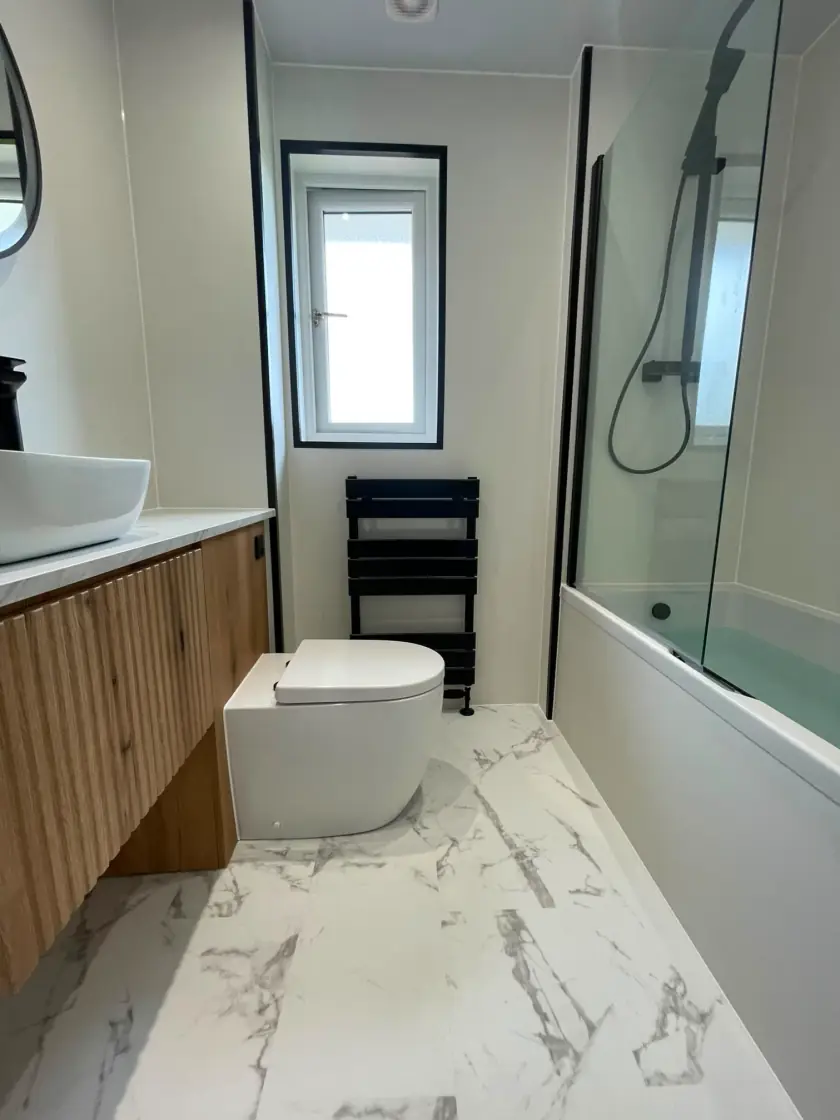
Vinyl or Laminate Flooring for a Bathroom?
Updated 11 October 2026
Vinyl and laminate can look similar in photographs, but their construction and installation requirements differ. For a bathroom, choose an exact product approved for the intended use rather than relying on a waterproof label. This guide helps Glasgow homeowners compare preparation, joints, cleaning and the fitted price before selecting a floor finish.
Check the product's bathroom instructions first
Vinyl flooring includes sheet products, glue-down tiles or planks and various click systems. Laminate usually has a layered construction with a wood-based core, although specifications vary. These are broad categories, not a guarantee of bathroom suitability. Ask for the installation and warranty documents for the exact range. Confirm whether it is intended for an ordinary bathroom with a separate shower tray or for a continuously wet shower-floor arrangement.
For example, Quick-Step's bathroom laminate guidance specifies additional finishing products for water resistance. Karndean's glue-down installation guidance excludes rooms that remain continually wet. Those details show why a general material label is not enough. A water-resistant or waterproof surface does not, by itself, make the entire floor construction a wet-room system.
Ask what preparation the existing floor needs
The installer should check the floor beneath the new finish for condition, moisture and suitability. Unevenness, movement or damaged boards may need work before either product is laid. Ask what is included in the preparation price and what cannot be confirmed until the old covering is removed. Laying a new finish over a known problem can leave the same fault hidden underneath rather than fixing it.
Check the complete floor height, including any underlay or preparation layer. It affects doors, thresholds, toilet connections and the shower entrance. If underfloor heating is proposed, confirm compatibility across the heating system, finish and installation materials, including temperature limits. Our bathroom heating comparison explains the wider decisions. Do not choose the flooring first and assume every heating arrangement can be added beneath it later.
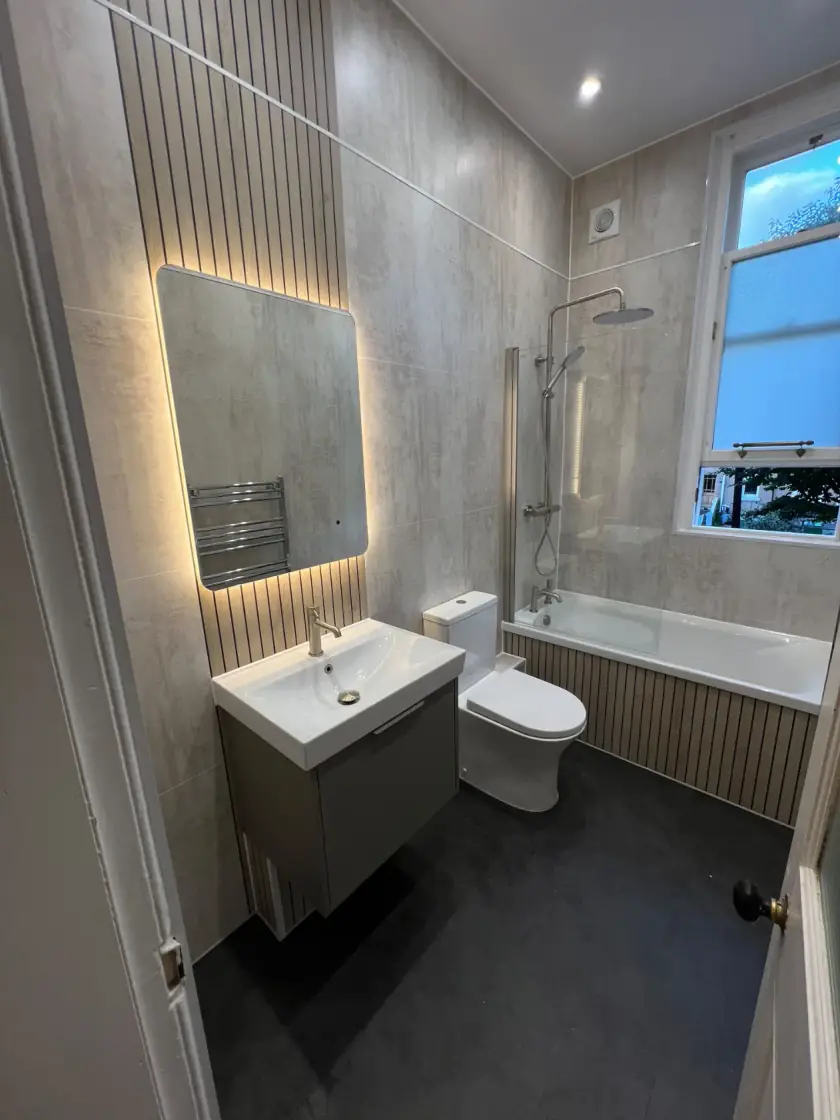
Compare joints, edges and everyday use
Ask how the selected system is finished around the bath, tray, pipes and room perimeter. Some floating floors need movement space and a specific method of sealing exposed edges. Glue-down and sheet systems have different requirements. The installer should follow the product's instructions rather than applying the same approach to every floor. Confirm how fixed furniture and sanitaryware interact with the floor so the finished arrangement remains suitable.
Consider the household's routine, including splashes, cleaning and any equipment used in the room. Ask for relevant wet slip-resistance information rather than judging by a textured or matt appearance. No finish should be treated as a reason to leave leaks unattended. A wet-room shower needs a system designed for that purpose; ordinary bathroom laminate or luxury vinyl tiles (LVT) should not be extended into it simply to maintain one visual pattern.
View samples and compare care requirements
Look at a sample beside the wall and vanity finishes in your own light. Ask to see the size and repeat of the plank or tile pattern. A small sample may not show how often a printed knot or vein repeats across the room. Compare the proposed laying direction and any border or threshold detail before ordering. The best-looking sample is not necessarily the best complete layout.
Follow the actual cleaning instructions, including which detergents, tools and cleaning machines are permitted. Do not assume every vinyl floor tolerates every bathroom spray or that all laminate can be cared for in the same way. Ask how a damaged section could be repaired and whether keeping appropriate spare material is useful. Product care and access for repairs are more informative than a blanket promise of a fixed lifespan.
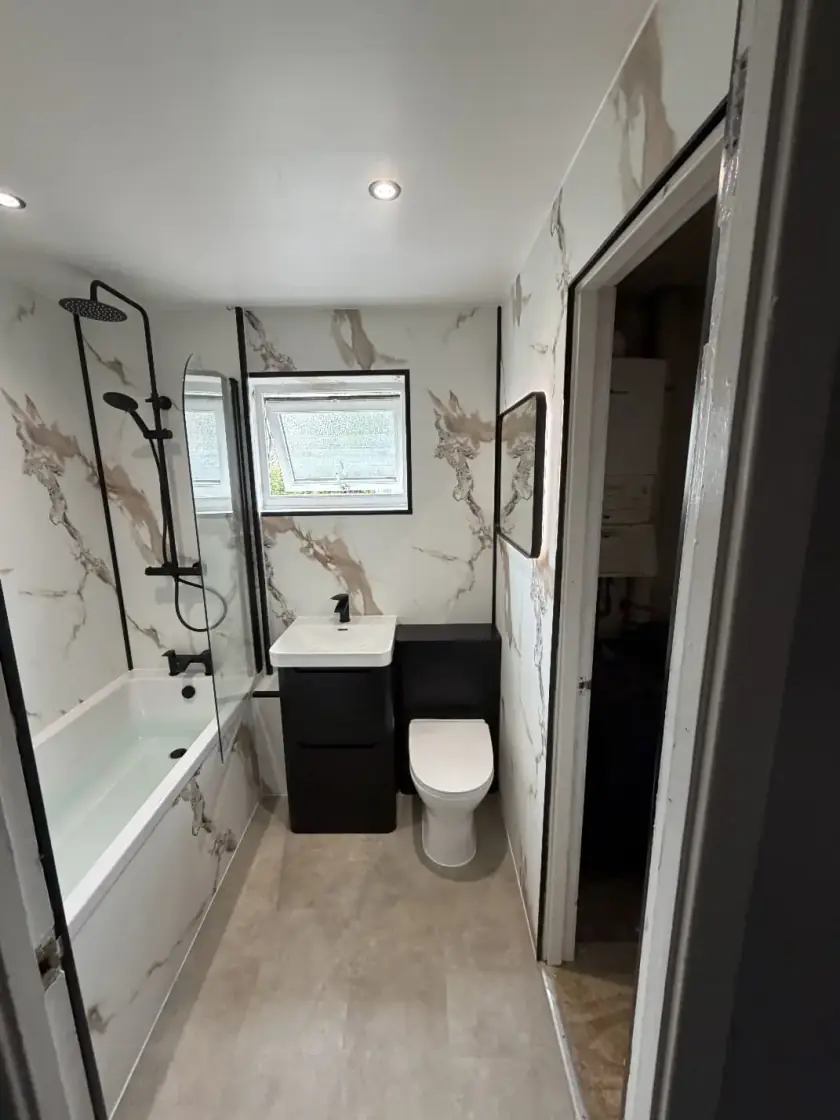
Compare the complete fitted cost
Include removal, waste disposal, preparation, moisture checks, underlay where required, adhesives, finishing products, trims and labour in the quote. A lower price per square metre can be outweighed by preparation or extra components. Ask what happens if damaged flooring is found when the old bathroom is removed. Keep the exact range and colour in the specification, and have any proposed substitute checked before it is supplied.
Our bathroom design service in Glasgow can discuss the floor with the rest of the refit. Call 0141 471 9145 with details of the existing room and the finish you like. At handover, keep the product instructions, warranty and installation details. Check when the floor can be used and cleaned, and report any movement, lifting or recurring damp rather than hiding it beneath a mat.
If you are also considering tiles, read our tile and LVT comparison. Compare realistic options for the same room and preparation, not a premium version of one material against a basic version of another. Bathroom suitability, a sound installation and care you can manage should guide the final choice alongside appearance and price.
Plan your bathroom in Glasgow
Talk through your room, the changes you want and the work that needs to be included.